Dress Size Chart
Finding the right apparel can turn out to be an extremely tough job, especially when it comes to making a purchase online. It is very common to get an item that is either too small, too big, or simply not the right fit for you because different brands and countries have different sizing systems. This guide is the most excellent reference for you to learn the clothing size charts. We are going to reveal the meaning of sizes and labels, thus giving you the power to choose the right size for all the clothes in your closet with complete assurance. Dress Size Chart is your way to go. This will include the shirt length chart, shirt size chart, t-shirt size chart, t-shirt sizes, hoodie size chart and jeans size chart. We will cover everything that you were in doubt about in the past, from shirts and trousers to coats and footwear, so your next purchase will be absolutely perfect.
Understanding the Basics of Apparel Sizing
It is essential to understand the leading cause of size inconsistencies when we start discussing specific garment types. Presently, there is no legally binding and universally accepted sizing standard for garments throughout the world. For their own fitting purposes, manufacturers create their own size charts according to the type of customers they target and the kind of fit they consider best. As a result, a medium size from one label might actually be a large size from another.
The most effective way to deal with this situation is to be aware of your own measurements. Taking a few crucial measurements will alter your shopping experience significantly. All that you will need is a soft measuring tape.
Chest: Tap around the most voluminous part of your chest while the tape remains parallel to the ground.
Waist: Take the measurement around your natural waistline, the narrowest part of your torso.
Hips: Take the measure around the most voluminous part of your hips and bottom.
Inseam: Start measuring from your crotch right down to your ankle.
After getting these numbers, you can easily match them with a chart for shirts or sizes for pants of a brand to find your exact size.
Navigating International Sizing: UK vs. USA Size Charts
International shopping has expanded our fashion choices, but it has also made the sizing issue more complex. A USA size chart can differ in a very big way from a UK size chart. For instance, US women who wear size 12 usually end up with a UK size 14. The size of men’s clothing, however, is generally of lesser trouble and more so for the items that are based on measurements, reference as collars or waists. Still, it is a good practice to always look into the specific international conversion chart provided by the retailer to avoid any uncertainties.
Cracking the Code of Shirt Sizes
Shirts are a staple, but finding the right fit can be tricky. Whether you’re looking for a formal button-down or a casual tee, the right size makes all the difference.
Men’s Shirt Sizes: Casual and Formal
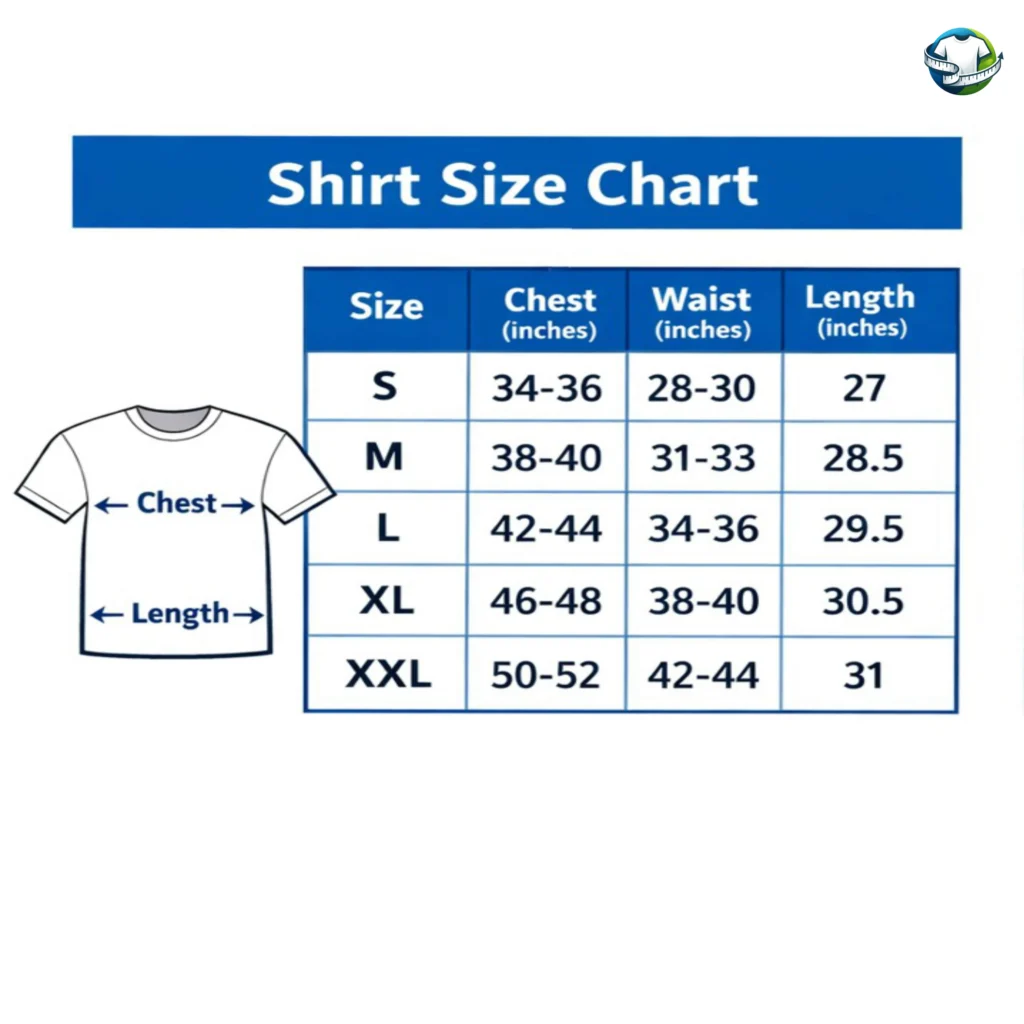
In the case of men’s casual tops, such as t-shirts and polos, the size is indicated by S, M, L, XL, and so on. However, what is called for a large size may vary. The measurement of the chest usually defines a man’s shirt size. For example, a man’s large size can be a chest measurement of 42-44 inches. For adults, a large-size shirt chart is ideal for accurately measuring their size.
When you encounter a size labelled ‘XL’, it is most likely associated with a larger chest and body measurement. In order to discover the exact shirt XL size, you have to check the specific brand’s shirt size measurements chart. The shirt sizes for men will present the chest, waist, and even length measurements to make sure that the fit is right.
Formal shirts, according to a gentleman’s shirt size chart, typically adopt a more accurate and traditional two-number sizing system. These two numbers indicate the neck measurement and the length of the sleeve. For instance, a size may be given as 15.5 / 34–35, where 15.5 inches refers to neck size and the corresponding arm length for the sleeve is 34 to 35 inches. This method of indicating size in two measures, which is typically discussed in a gentleman’s size chart, gives a more precise and comfortable fit than standard sizing.
Women’s Shirt Sizes: Blouses and Tops
Usually, a woman’s shirt size is determined primarily by the bust measurement. Sizes may be shown in numerical formats (such as 2, 4, 6, or 8) or alphabetical formats (XS, S, M, L). A detailed women’s shirt size chart typically includes bust, waist, and hip measurements to help you choose the best fit, as women’s shirt cuts can vary significantly. Some styles are designed to hug the waist, while others feature a relaxed or straight cut.
The Essential T Shirt Size Guide
T-shirts are one of the clothing items that are worn all over the world, but their sizes can be very confusing. A T-shirt size chart is necessary to determine the right tee to be determined. Here is a straightforward description:
Unisex T Shirt Sizes: The rates are basically formed on men’s sizes and are meant to be very loose. Women would have to shrink down a size if they want the t-shirt to be more fitted.
Men’s T Shirt Sizes: The cut is carried out for the widest shoulder and straight body type. The men’s shirt size chart will mainly emphasize the chest girth.
Women’s T-Shirt Sizes: It is commonly a fitting one, with narrower shoulders, a tapered waist, and the bust area with the most allowance.
Length of the shirt chart is another important thing to consider and especially for very tall or short people. It indicates the length of the garment from the highest point of the shoulder to the lowest edge, thereby ensuring that you do not buy very short shirts unwittingly or shirts that look like gowns.
Youth Shirt Size Guide
Buying clothes for children is not the same as buying for adults, and hence a different approach is needed. A youth shirt size guide categorising sizes by age is there, but a shirt measurement chart is much more dependable. A youth tee shirt size chart would generally guide you by listing the chest and height measurements for you to find the fit suitable for a growing child. Sizes are frequently put in groups like Small (6-8), Medium (10-12), and Large (14-16), but it is important to confirm against the specific brand’s chart.
Finding the Perfect Fit for Your Bottoms
From tailored trousers to casual jeans, getting the right size for pants is key to both comfort and style.
Mastering the Pant and Trouser Size Chart
For measuring, the waist is the primary spot for both men’s and women’s trousers. A pant size chart shows the corresponding sizes for specific waist and hip measures. In men’s sizing, it’s very much a simple process; the size is generally given just as Waist x Inseam (e.g., 34×32). So, a waist of 34 inches and an inseam of 32 inches.
The chart for women’s trousers generally employs a numerical system (e.g., 0-20) that correlates to definite waist and hip ranges. It is very important to check the chart as the sizes are not universal. More precise information regarding the rise (i.e., from the crotch to the top band) will indicate if the pants are going to be at your waist, on your hips, or at some point between the two.
The Definitive Jeans Size Chart
Sizing of jeans is really a thing of its own. Standard waist and inseam measurements (W/L) are used by many brands, but others create a unique numerical styling system. A jeans size chart is your best friend here.
Men’s Jeans: Normally, the W/L format is used. For a 34-inch waist and a 34-inch inseam, a size 32×34 jean is for a 34-inch waist and a 34-inch inseam.
Women’s Jeans: Usually, this is more complicated. Sizing might be given in waist size (26, 27, 28) or by a dress size equivalent (4, 6, 8). It is always advisable to check the brand’s chart for size conversions. For instance, a size 28 in one brand could be equivalent to a US size 6, while in another, it could be a size 8.
The Jacket Size Chart Explained
Typically, men’s jacket size charts imitate the sizes of suits, and this is done by using the circumference of the chest in inches (for example, 38, 40, 42). Besides that, there exist different lengths for jackets: Short, Regular, or Long to serve the various heights of people better. The sizing of women’s jackets, conversely, is often done using the alphabetical (S, M, L) or numerical (4, 6, 8) systems. When it comes to choosing a jacket, it is advisable to wear similar kinds of clothing that you usually have on underneath in order to ensure the right size.
Hoodie and Coat Size Charts
Hoodies are mainly focused on comfort, thus their sizing is mostly larger. The size chart for hoodies is most of the time simple, with sizes S, M, L, and XL corresponding to the measurements of the chest. A lot of individuals prefer to go one size larger for a fit that is loose and comfortable.
The coat size chart resembles the one for jackets. Coats are the first layer of clothing, and thus they have a little more allowance space. Usually, just your regular size will be enough, and it will be comfortable over a knit. On the other hand, if you are going to wear very thick layers or the coat is of the very slim-cut style, you may want to go a size up. Always check the brand’s suggestions and measurement chart.
Don’t Forget Your Feet: The Shoe Size Chart
One of the major areas of international differences is shoe sizing. A shoe size chart is always required when purchasing shoes from another country.
US vs. UK vs. EU: Out of all the different sizing systems available, these three are the ones usually accepted universally. For example, women’s size 8 in the US is the same as a size 6 in the UK and 38-39 in the EU. Men’s size 10 in the US is equal to 9.5 in the UK and 43 in the EU.
Measure Your Feet: To get the most accurate size, put your foot on a sheet of paper, trace it, and then measure from the heel to the longest toe. After that, you can check where this size fits on the shoe size chart in either inches or centimetres. Do this in the afternoon, as your feet might have swelled a little during the day.
FAQ’s
Your Go-To Resource for Sizing Success
It isn’t necessary to struggle with the different clothing sizes. Once you take your measurements and learn how to read the sizes for shirts, pants, or any other items, you can shop with absolute precision and confidence. This guide is meant to be your main resource for sizing and includes everything from a complete shirt measurements size chart to a comprehensive t-shirt size guide. Think of it as your reliable source to ensure that every new piece of clothing you buy will be of the correct size for you.